
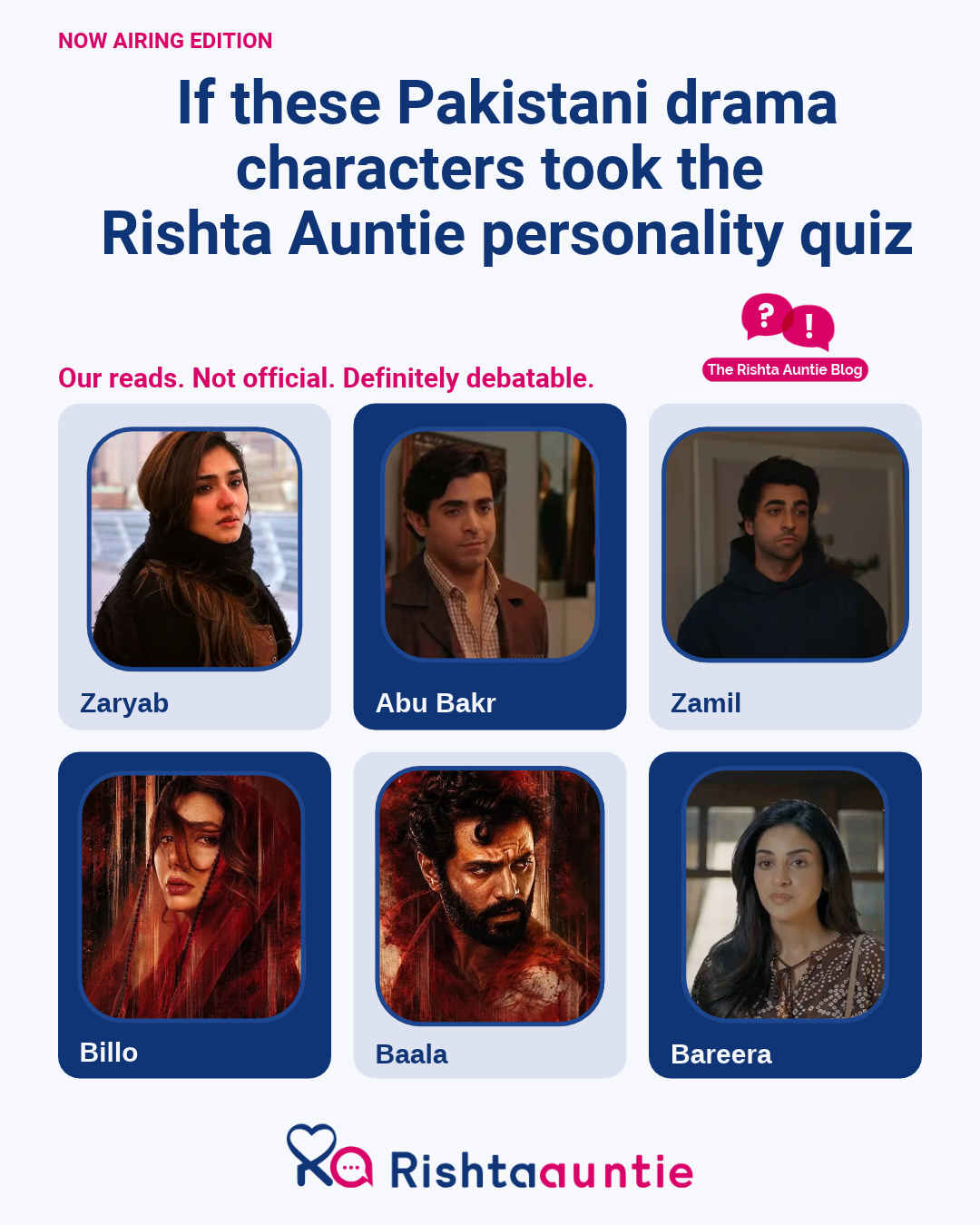
12 Pakistani Drama Characters & Their MBTI Types (2026)
Zaryab, Zamil, Billo, Bareera, Ansa and seven more, run through the personality quiz inside Rishta Auntie. Plus four pairs who got the exact same result and have nothing else in common.
Unofficial, opinion-based reads of fictional characters, for fun and debate. The results are imagined, since fictional characters can’t sit a quiz. They aren’t official MBTI assessments, and nothing here is a judgment of the actors.
Dar-e-Nijaat is 25 episodes in and still the drama everyone has an opinion on. Nashtar and Mitti De Baway still have the family group chat arguing every week. Bas Tera Saath Ho, Zanjeerain and Aap Ki Izzat have wrapped, so the arguments have moved on to the endings: who was wrong, who ignored the red flag, who should have left six episodes ago.
We’d like to add one more argument.
The Rishta Auntie app has a 26-question personality quiz that gives you a four-letter, MBTI-style type. So we imagined the characters everyone’s been fighting about sitting down to take it.
How we scored them. Nobody got a result for being likable. We answered the way we think each character would, going by how they talk, decide, fight and love. “If they retook it” is our closest alternate. The “most ___-coded” lines are ours, not dialogue.
EARLY READ 👀 means the show is new. Mitti De Baway is only about ten episodes into a much longer story, so Billo and Baala’s results could still change.
And no, the quiz isn’t a morality test. It tells you how someone operates, not whether they’re kind or right. Four pairs here got identical results and couldn’t survive one dinner together.
Cheat sheet: E or I = think out loud, or think first. S or N = what’s in front of you, or what could be. T or F = logic and consistency, or values and people impact. J or P = a settled plan, or open options.
Pencils down.
1. Zaryab: ESFJ
Dar-e-Nijaat · Durefishan Saleem

The short version: Zaryab builds her future around the people she loves. She looks carefree until a relationship wobbles, and then she wants answers, reassurance and a plan.
She’s the friend who texts “can we talk?” and means now, not after chai.
Feeling is the loudest letter here. Every big change gets measured by what it does to “us.” The S will get pushback because she’s ambitious, but her logic runs on what she’s actually lived. We had this plan. You were this person. When did that change? And uncertainty makes her itch, which is about as J as it gets.
If she retook it: ENFJ
Most Zaryab-coded: “Wait… when did WE change the plan?”
2. Zamil: ESFP
Dar-e-Nijaat · Nameer Nawaz Khan

Our most controversial result, from the guy most likely to retake the quiz twice and get two different answers.
His changing relationship with faith isn’t a personality trait, and the quiz doesn’t measure it. We’re scoring how he reacts when his sense of self slips.
The short version: Zamil feels everything at full volume and reacts the same way. When his life stops matching who he thinks he should be, he swerves before he’s dealt with the fallout.
The P was the easiest call on this list until he started scheming, and we’re keeping it: something feels wrong, change everything, now, deal with it later. He reacts to whatever is in front of him, Abu Bakar standing there being calm included. His jealousy and guilt never stay private. And every decision gets tangled up in what kind of man he’s supposed to be.
If he retook it: ISFP
Most Zamil-coded: “I need to change my entire life. Immediately.”
3. Abu Bakar: ISFJ
Dar-e-Nijaat · Sheheryar Munawar
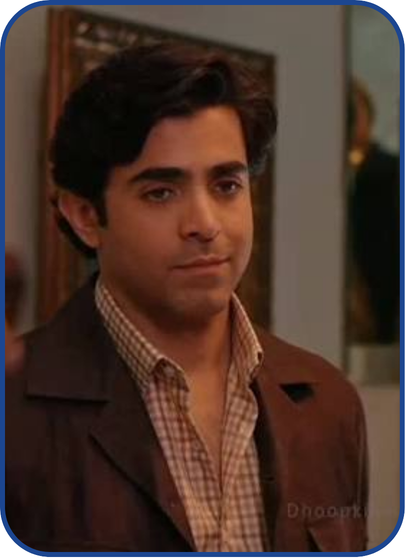
The short version: Abu Bakar doesn’t advertise his values. He lives them, quietly, with a lot of patience and a line he won’t cross.
He’d answer every question honestly, once, and never check his result. Every khala at the wedding would call him “bohat suljha hua,” and for once the khalas would be right.
He doesn’t perform his faith, his feelings or his masculinity. The F is what keeps him from reading like a rulebook: when someone is vulnerable, his principles show up as patience and respect for their choices.
Zamil is still looking for who he’s supposed to be. Abu Bakar already knows and just gets on with it.
If he retook it: ISTJ
Most Abu Bakar-coded: He doesn’t need to prove who he is.
4. Billo (Bilqees Bano): ESFP
Mitti De Baway · Mahira Khan

EARLY READ 👀
The short version: Billo feels deeply and almost never sits still with it. Young Billo chases what she wants. The Billo in charge years later is colder and far more controlled.
That gap is the whole puzzle. Young Billo is bold, playful and loud about what she feels, and everything she does runs on love, loyalty and betrayal. The P is the shakiest letter we gave anyone. If present-day Billo took the quiz, a J wouldn’t shock us. Both versions make the same move: feel it, decide, act.
If she retook it: ENFJ
Most Billo-coded: She turns feelings into action.
5. Baala (Iqbal Channan): ISFP
Mitti De Baway · Wahaj Ali

EARLY READ 👀
The short version: Baala says less than he feels. He follows his instincts, pushes against the life picked for him and carries his attachments quietly, years later.
Young Baala would probably test ESFP. The man who comes back says it with a look, a pause or nothing at all, and still goes after the opening when he sees one.
If he retook it: ESFP
Most Baala-coded: Says less than he feels.
6. Shah Dawood: ESTJ
Nashtar · Danish Taimoor

He’d only take our quiz if he’d commissioned it, and he’d argue with the result.
It’s easy to file Dawood under “angry rich guy,” and the way Nashtar handles his behavior toward Bareera has drawn real criticism. We think the pattern is more specific than temper.
The short version: Dawood expects the world to run on rules, hierarchy and respect. When someone refuses his authority, the need for order becomes a need for control.
J is his strongest letter. Challenge him and he goes straight to confront, command, restore. He keeps score in concrete terms: reputation, status, who embarrassed him in public. Power and outcomes win over empathy every time.
He’s emotional, sure. Shouting isn’t an F. His real problem is control turning into entitlement.
If he retook it: ENTJ
Most Dawood-coded: If he can’t control the situation, he tries to control the person.
7. Bareera Aijaz: ENFP
Nashtar · Anmol Baloch

The short version: Bareera puts conviction before convention. Titles don’t impress her when something’s wrong, and she’ll take on the whole room before she keeps quiet for the sake of peace.
She’s the one asking the uncle at the dinner table “but why?” and actually waiting for an answer. That question is the whole N, and it’s how she ends up across the room from someone like Dawood.
Her F points inward. The question underneath it is whether she can live with herself if she accepts this. Values firm. Method adaptable.
If she retook it: ENFJ
Most Bareera-coded: “Just because everyone accepts it… why should I?”
8. Anas: ISFJ
Bas Tera Saath Ho · Farhan Saeed

On every question he’d pick the answer that keeps everyone else comfortable. Which is also his result.
The short version: Anas carries responsibility quietly and puts everyone else first by reflex. His loyalty runs deep, and so does his habit of dodging fights that need to happen.
He’s the son who says “koi baat nahi” while the roof comes down on him. Family, promises and the way that house has always worked decide most of his choices, and even his worst calls usually come from trying to protect someone.
The J is what traps him. Promises turn into a cage. The instinct that makes him dependable also makes him far too willing to absorb harm.
If he retook it: INFP
Most Anas-coded: He’d rather carry the burden than start the fight.
9. Ansa: ESTJ
Bas Tera Saath Ho · Sana Javed

And yes, she got the same four letters as Shah Dawood. Hear us out.
The short version: Ansa doesn’t believe problems disappear if you stay quiet. She protects people through action and has no patience for injustice dressed up as “keeping the peace.”
In a fight she’s Anas’s opposite. She’s the cousin who says at the dinner table what everyone else only says in the car on the way home. She keeps track of who did what, what belongs to whom and what happens next.
The T is where you’ll fight us, because she’s clearly compassionate. Compassion isn’t an F result, though. When it comes down to it, she picks truth and accountability over everyone’s comfort. Name it, hold someone responsible, fix it.
If she retook it: ESFJ
Most Ansa-coded: If it’s wrong, say it. Then do something about it.
10. Rabiya (Biya): ISFP
Zanjeerain · Sajal Aly

The short version: Rabiya feels everything and broadcasts none of it. She follows her own moral compass, shows love through action and keeps adapting to a life she didn’t choose.
Calling her an introvert might raise eyebrows, because she can absolutely hold her own. But the grief, guilt and fear stay inside. Confrontation is something she does when she has to, not where she lives. She works, handles what’s in front of her and gets on with it, bending with whatever life throws at her instead of forcing a plan on anyone.
If she retook it: ISFJ
Most Rabiya-coded: She doesn’t talk about being strong. She handles what’s in front of her.
11. Behram: ESTP
Aap Ki Izzat · Saif Ali Khan

He’d spend the first five questions working out which answers get the best result.
ESTP isn’t a villain type. We’re scoring his style; his choices are his own problem. (And yes, that Saif Ali Khan: the Tamasha winner in his first drama, not the Bollywood one.)
The short version: Behram lives in the moment and works whatever lands in front of him. Charming when it pays, quick to switch when it doesn’t.
He reads a room the way a sabzi wala reads an aunty about to haggle: push when he can get away with it, back off the second the ground shifts. Every opening gets sized up on the spot. Relationships look transactional to him, and his question is always “what do I get?”
If he retook it: ENTP
Most Behram-coded: If there’s an opening, he’s taking it.
12. Shehreen: ESFJ
Bas Tera Saath Ho · Zoya Nasir

She’d check everyone else’s result before reading her own. She’s also living proof that F does not mean nice.
The short version: Shehreen reads people and rooms brilliantly. She cares about status, relationships and appearances, and that awareness turns into a weapon when her position feels threatened.
She knows exactly what will embarrass someone, what earns approval and what costs a reputation. Using that unkindly is still feeling. The letter is about what you notice, not whether you’re nice about it. She’s memorized the seating chart at every family wedding. She believed in a set future, and when it started falling apart, she reacted hard.
If she retook it: ESTJ
Most Shehreen-coded: She always knows where everyone stands socially.
Same result. Completely different person.
Four pairs walked out with identical results. That was the point.
Zaryab vs Shehreen (ESFJ). Both read people closely. Zaryab uses it to find connection. Shehreen uses it to protect her position.
Shah Dawood vs Ansa (ESTJ). Both confront, decide fast and hate ambiguity. Dawood does it to keep control. Ansa does it to get fairness. You would not want them settling the same family dispute.
Abu Bakar vs Anas (ISFJ). Both quiet, dutiful and loyal. Abu Bakar’s boundaries are firmer. Anas’s dissolve. One carries responsibility; the other gets buried under it.
Baala vs Rabiya (ISFP). Both private and deep, both show love by doing. Baala is romantic and rebellious. Rabiya is practical and protective. Same wiring, pointed in different directions.
Same broad preferences. Different values, maturity, circumstances and choices. A personality quiz, ours included, can tell you how someone operates. It can’t tell you what they believe, how they treat people or whether they’ve grown up.
What does any of this have to do with compatibility?
We didn’t put a personality quiz in a marriage app because we think four letters pick your spouse. Nobody can honestly tell you ESFJs should marry ESTPs. Anyone selling MBTI that way is selling horoscopes with extra steps.
What a result does give you is language. Why one of you needs to talk it out tonight and the other needs a day. Why one wants the five-year plan and the other wants options.
Two people can have chemistry and matching results and still disagree on the things that actually decide a marriage: when, where you’ll live, how religion shows up day to day, how involved family will be, kids, money and how you fight. Two people with opposite results can do fine if they line up on those.
So your result is one signal in your Rishta Compass, next to values, lifestyle, family expectations and what you’re actually looking for. A lens, not a verdict.
Four letters can tell you something. They can’t tell you everything.
Now tell us where we’re wrong
Is Zamil secretly an ENFP? Is Ansa obviously an F? Does Billo turn into a J once we see who she became? Tell us which result you’d change, who should have taken the quiz and which drama goes next.
And if you’re more curious about your own result than Zamil’s latest identity crisis, the personality quiz is inside Rishta Auntie. Take it and see where it lands in your Rishta Compass. Fewer plot twists, we promise. The Rishta Auntie app is now available on Android and iOS in the US & Canada.


